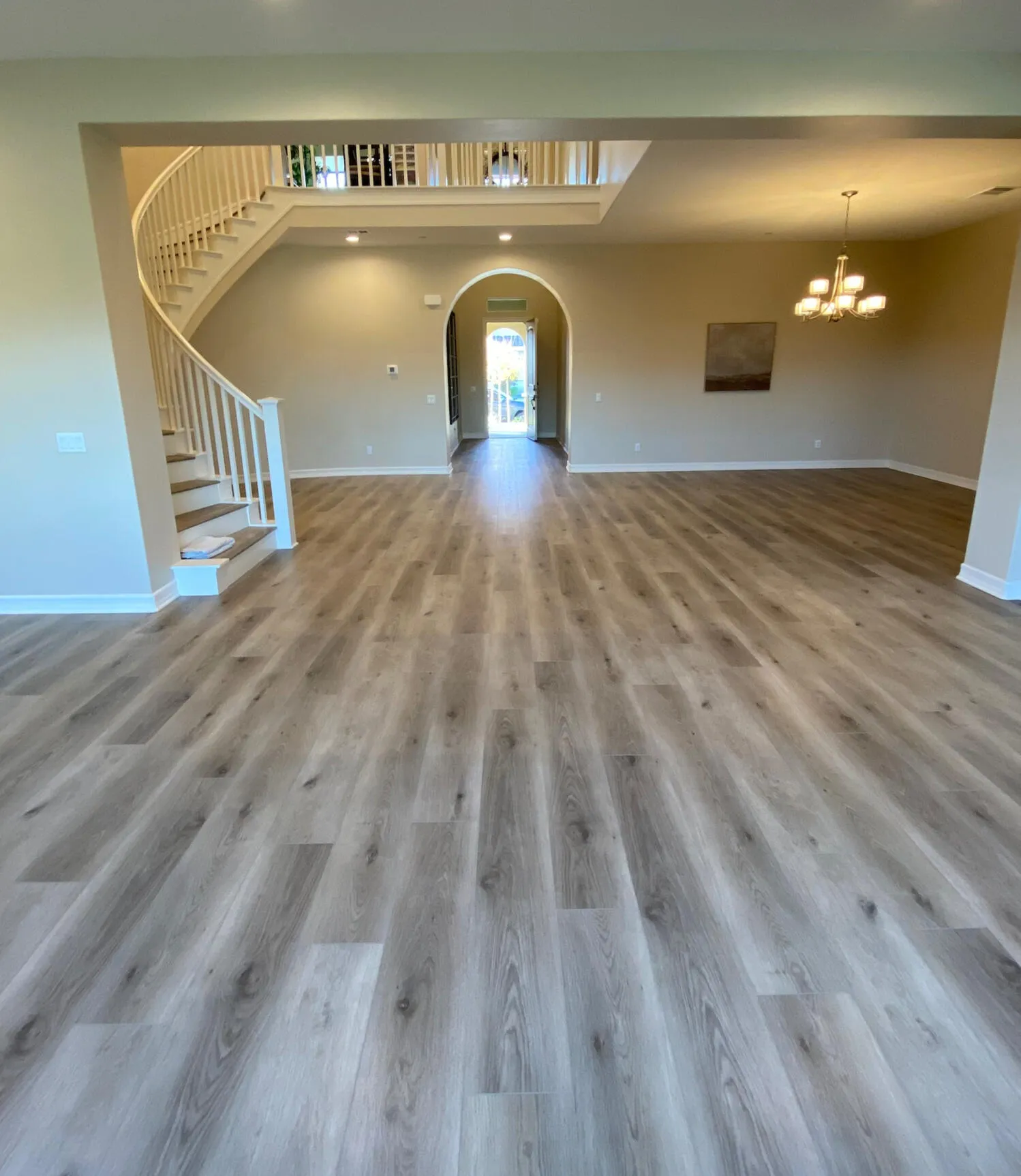
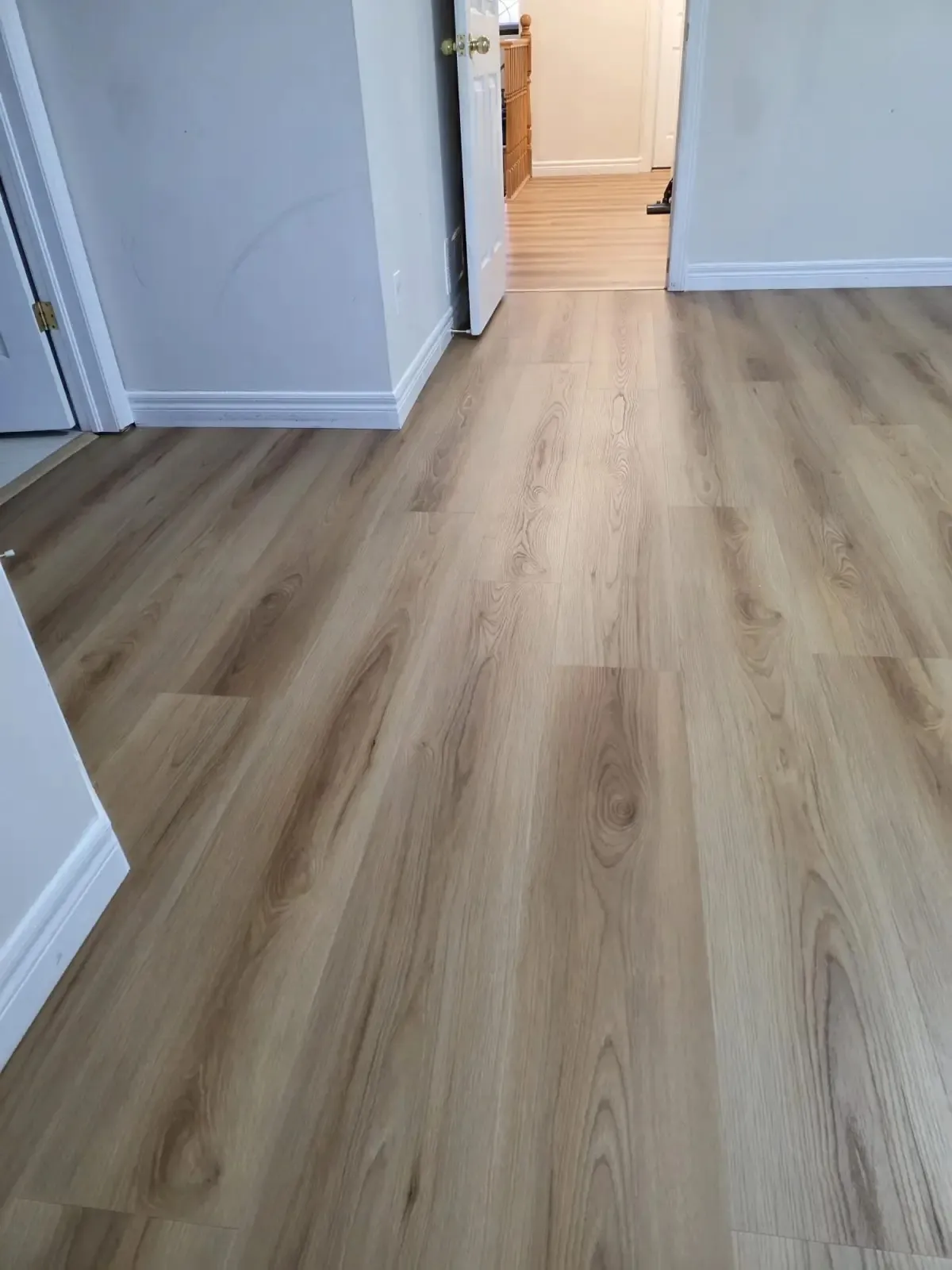
Kitchens and bathrooms demand flooring that handles moisture, spills, and heavy foot traffic without giving up comfort or style. Our answer in 2026 is the same in every Bay Area project we quote: premium LVP or SPC. This post walks through why — and the room-specific details that separate a good wet-room install from one that peels open in eighteen months.
Wet rooms play by different rules
Your kitchen and your bathroom are the two rooms where flooring takes the most abuse. Standing water from a splashing sink, steam from the shower, spills from cooking, dropped dishes, heavy foot traffic — these rooms demand flooring that can handle all of it without warping, staining, or becoming a slip hazard.
In the Bay Area specifically, many older homes have subfloor issues in kitchens and bathrooms — moisture wicking up through slab foundations, inadequate ventilation, and decades of minor leaks that nobody noticed. The right flooring choice accounts for these conditions. The wrong one fails within a few years and drags the subfloor down with it.
Why we install LVP/SPC in every wet room we touch
Premium luxury vinyl — specifically the SPC (stone polymer composite) tier with a 20-mil or thicker wear layer — is engineered for exactly this job. The core is plastic composite, not wood fiber, so water has nothing to absorb. The wear layer is the same tough, UV-cured film used in commercial installations. The click-lock system floats over almost any flat subfloor. No mortar, no grout, no cure time, no seven-year replacement cycle.
Why it works in kitchens and bathrooms
- Waterproof core
- SPC — zero absorption
- Wear layer
- 20 mil commercial-grade
- Temperature comfort
- Warm underfoot
- Install time (kitchen)
- 1 day
- Install time (bath)
- Half-day
- Best for
- Kitchens, baths, laundries, basements
The specific product we install most is GAIA Impala — 20-mil wear layer, 6.5 mm SPC core, Uniclic click-lock, integrated IXPE underlayment, UV-cured EnduraPro surface. For the full technical deep-dive, see our GAIA Impala write-up.
We don't install the builder-grade LVP that peels open in three years. Premium only — 20-mil wear layer minimum, SPC core, real warranty on the product.
In the kitchen — what matters
Kitchens are traffic + moisture + point loads all in one room. You're standing for hours at a counter, the dishwasher cycles twice a day, the fridge door opens thousands of times a year, and every now and then someone drops a cast-iron pan. Premium LVP handles all of it — but only if the install respects a few kitchen-specific details.
- Plank direction — Run planks parallel to the longest wall. Kitchens with islands look best when planks run along the island's long axis, not across it.
- Expansion gap at every wall — 3/8 inch minimum, hidden behind baseboards and shoe molding. LVP is plastic and moves with temperature — pinning it causes ripples.
- Around the sink — We seal the perimeter of the sink-base cabinet with silicone caulk where the plank meets the toe-kick. Splash-out from the sink is the number-one source of slow leaks that damage subfloors.
- Under the dishwasher — Planks continue wall-to-wall, including the dishwasher space. If the dishwasher ever needs to come out for replacement, the floor is already under it. No surprise bare subfloor showing.
In the bathroom — what matters
Bathrooms add a few wrinkles kitchens don't have: the toilet flange, the tub or shower boundary, the vanity toe-kick, and ongoing humidity that never fully dries. Premium LVP handles every one of these, but the install details matter more than in a kitchen because the margin for error is smaller.
- Toilet flange cut — The plank gets a precision cut around the toilet flange so the toilet seats on the subfloor, not the plank. Never try to sandwich the plank under the toilet base — any wobble cracks the plank edge.
- Tub / shower edge — Plank stops short of the tub with a 1/8-inch gap, then bridges to the tub with matched silicone caulk. Water that runs down the outside of the tub hits caulk, not the plank's locking edge.
- Vanity toe-kick — If the vanity is already installed, plank goes wall-to-wall up to the toe-kick. If the vanity is coming new, plank goes wall-to-wall first and the vanity sets on top — cleaner line, easier future replacement.
- Vent placement — Every full bath needs a working exhaust fan. If yours vents into the attic instead of outside (common in 1960s–80s Oakland homes), flag it before we install. Moisture trapped in the ceiling cavity ruins the ceiling before it ever touches the floor.
What to avoid in wet rooms
Some flooring types that work beautifully elsewhere have no business in a kitchen or bathroom. We pull these out of East Bay homes regularly after they've failed:
- Solid hardwood in wet rooms — Water absorption causes cupping, warping, and buckling. One plumbing leak destroys it. Solid hardwood belongs in living rooms, dining rooms, and bedrooms — not anywhere water lives.
- Standard laminate — The HDF core swells when wet. Even "water-resistant" laminate only buys you time to clean up spills — it isn't truly waterproof. The edges puff up first, then the whole board delaminates.
- Unfinished wood of any kind — If it can absorb water, it doesn't belong in a bathroom or kitchen. Reclaimed wood, bamboo without a waterproof coating, any site-finished wood in a wet room — skip it.
- Carpet — This should be obvious, but we've pulled soggy, moldy carpet out of bathrooms more times than we'd like to admit. Prior-owner installs, mostly. Just don't.
What a typical wet-room install costs
Here's what we quote for single-room projects in the Bay Area. All numbers are installed — materials, labor, demo of the old floor, transitions, and baseboards where needed:
Single-room LVP / SPC install — Bay Area
- Kitchen — 150-250 sq ft $1,500 – $3,000Single-room LVP install, demo + transitions included
- Full bathroom — 60-80 sq ft $650 – $1,200Plank install around toilet flange + tub edge
- Powder / half-bath — 30-40 sq ft $400 – $700Minimum day-rate applies; batch with kitchen to save
- Laundry room — 50-80 sq ft $500 – $1,000Extra moisture-seal at washer drain pan
For whole-home LVP installs where kitchen and bathrooms are included in a larger scope, cost drops per square foot because the crew is already on site. Our cost calculator handles the math in 60 seconds.